Microsoft July 2026 Patch Tuesday Breaks Records: Why 570 Security Fixes Matter for Your Business


Microsoft's July 2026 Patch Tuesday wasn't just another monthly update. It was the largest Patch Tuesday release Microsoft has ever published.
The July 2026 security updates addressed 570 vulnerabilities, including three zero-day vulnerabilities—two already being exploited in active attacks and one publicly disclosed before patches became available. Microsoft also fixed 59 critical vulnerabilities, including 48 remote code execution flaws, making this one of the most significant security releases in recent memory.
The three zero-day vulnerabilities drawing the most attention this month are CVE-2026-56155, CVE-2026-56164, and CVE-2026-50661. Two of these vulnerabilities are already being actively exploited in the wild, while the third was publicly disclosed before a security update became available. Organizations using Active Directory Federation Services, Microsoft SharePoint, or BitLocker should prioritize these updates as part of their emergency patching process.
The sheer number of vulnerabilities tells an important story. Cybercriminals aren't slowing down. And organizations that still approach patch management as a monthly maintenance task are falling further behind.
A Record-Breaking Patch Tuesday
Microsoft has released large Patch Tuesday updates before, but nothing on this scale.
The July 2026 Patch Tuesday release includes security fixes affecting Windows, Microsoft Office, SharePoint, Azure, Visual Studio, Microsoft Defender, and numerous other Microsoft products.
Among the most serious vulnerabilities are three high-profile flaws organizations should prioritize immediately:
CVE-2026-56155 – An actively exploited Active Directory Federation Services (ADFS) elevation-of-privilege vulnerability.
CVE-2026-56164 – An actively exploited Microsoft SharePoint vulnerability.
CVE-2026-50661 – A publicly disclosed BitLocker security feature bypass vulnerability.
In addition to these zero-day vulnerabilities, Microsoft patched hundreds of flaws that could allow attackers to execute remote code, elevate privileges, bypass security controls, or spoof trusted systems.
What makes this release especially concerning is not just the volume of vulnerabilities. Attackers are already exploiting some of them. When Microsoft releases patches for actively exploited vulnerabilities, every organization that delays updating effectively extends the attackers' window of opportunity.
Bigger Numbers Mean Bigger Operational Challenges
When most people hear "570 vulnerabilities," they assume IT simply needs to install updates. Reality is far more complicated.
Every patch cycle requires organizations to evaluate:
Which systems are affected
Application compatibility
Maintenance windows
Business continuity
Backup validation
Recovery planning
Third-party software dependencies
For organizations with multiple locations, hybrid infrastructure, remote employees, virtual servers, and Microsoft 365 environments, patching becomes an operational exercise—not just a technical one.
This is one reason SafeStorz emphasizes infrastructure standardization. Consistent server configurations, Microsoft 365 security baselines, and documented environments make patch management significantly more predictable than environments built over years of disconnected technology decisions.

The Real Risk Isn't the Patch Count
Most vulnerabilities never make headlines. Attackers don't need all 570. They only need one.
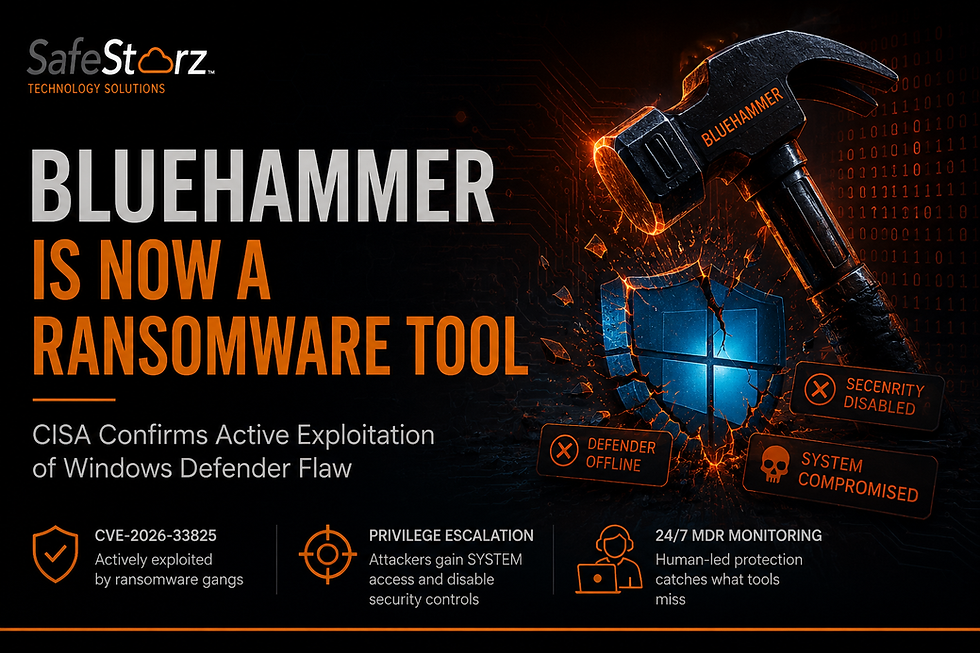
Recent attacks like BlueHammer demonstrated how quickly publicly disclosed vulnerabilities become ransomware tools. BlueHammer (CVE-2026-33825) demonstrated how quickly disclosed vulnerabilities become ransomware tools: on June 30, CISA confirmed ransomware gangs were exploiting the Microsoft Defender privilege escalation flaw more than two months after Microsoft patched it.
The same pattern repeats every month:
Microsoft releases security updates.
Researchers analyze the patches.
Criminals develop exploits.
Organizations that delay updates become targets.
The speed between disclosure and exploitation continues shrinking. That means every delayed patch increases business risk.
Patching Is Only One Layer of Defense
Installing updates remains one of the most effective security controls available. But no organization patches every system instantly. There is always a window between disclosure and remediation.
That's why SafeStorz approaches cybersecurity as a layered strategy rather than relying on a single control.
Our security approach combines:
Proactive vulnerability and patch management
Microsoft 365 and Intune security baselines
Cynet XDR visibility across endpoint, identity, network, and cloud
24/7 CyOps MDR monitoring and response
Private cloud infrastructure designed to reduce lateral movement
Managed backup and disaster recovery
Even when organizations are actively patching, continuous monitoring helps identify suspicious activity before attackers can expand throughout the environment.
Unsupported Systems Create the Biggest Blind Spots
One of the most common findings during SafeStorz infrastructure assessments is not missing patches.
It's systems that cannot be patched at all. Legacy servers. Unsupported operating systems. Business applications that no longer receive vendor updates.
These environments often remain in production because "they still work."
Unfortunately, attackers appreciate legacy infrastructure just as much as the businesses running it.
As Patch Tuesday releases continue growing larger, unsupported systems become increasingly dangerous because they simply fall further behind every month.
That's why lifecycle planning is just as important as patch management.
Why Human Monitoring Still Matters
Technology plays an essential role in cybersecurity. People complete the picture.
The July Patch Tuesday release reinforces an important reality: no IT department can manually investigate hundreds of vulnerabilities every month while simultaneously responding to users, managing projects, and supporting business operations.
SafeStorz combines Cynet XDR with 24/7 CyOps MDR, giving customers continuous monitoring by security analysts who investigate suspicious behavior around the clock.
That means if attackers attempt to exploit a vulnerability before every system has been updated, unusual identity activity, endpoint behavior, or lateral movement can still trigger an investigation.
Security doesn't stop at installing patches. It continues through detection and response.
Turning Patch Tuesday Into a Competitive Advantage
Organizations that consistently stay ahead of cyber threats treat Patch Tuesday as part of a broader security process—not a monthly emergency.
That process includes:
Regular vulnerability assessments
Timely patch deployment
Infrastructure lifecycle planning
Identity security reviews
Continuous threat monitoring
Business continuity testing
Each month brings new vulnerabilities. Each month presents another opportunity to reduce the attack surface before cybercriminals can take advantage.
Businesses that build repeatable security processes are far better positioned than those reacting to individual headlines.
Don't Let Record-Breaking Patch Counts Become Record-Breaking Problems
Microsoft's July 2026 Patch Tuesday is a reminder that the threat landscape continues evolving faster than ever. With 570 vulnerabilities, three zero-days, and 59 critical flaws, organizations cannot afford to assume yesterday's security strategy will protect tomorrow's environment.
For organizations running Microsoft environments, delaying updates for vulnerabilities such as CVE-2026-56155, CVE-2026-56164, and CVE-2026-50661 increases the likelihood of compromise. Applying security updates promptly, validating successful deployment, and monitoring for suspicious activity remain the best defense against emerging threats.
At SafeStorz, we help businesses stay ahead through proactive patch management, Microsoft security baselines, Cynet XDR with 24/7 CyOps MDR, private cloud infrastructure, and continuous infrastructure monitoring.
If you're unsure whether your organization is keeping pace with today's threat landscape, contact SafeStorz for an infrastructure and patch readiness assessment. We'll help identify security gaps before attackers do.