
CVE-2026-33825 - BlueHammer Is No Longer Just a Vulnerability. It's Now a Ransomware Tool.

Most security vulnerabilities become dangerous after attackers figure out how to exploit them.
BlueHammer has already crossed that line.
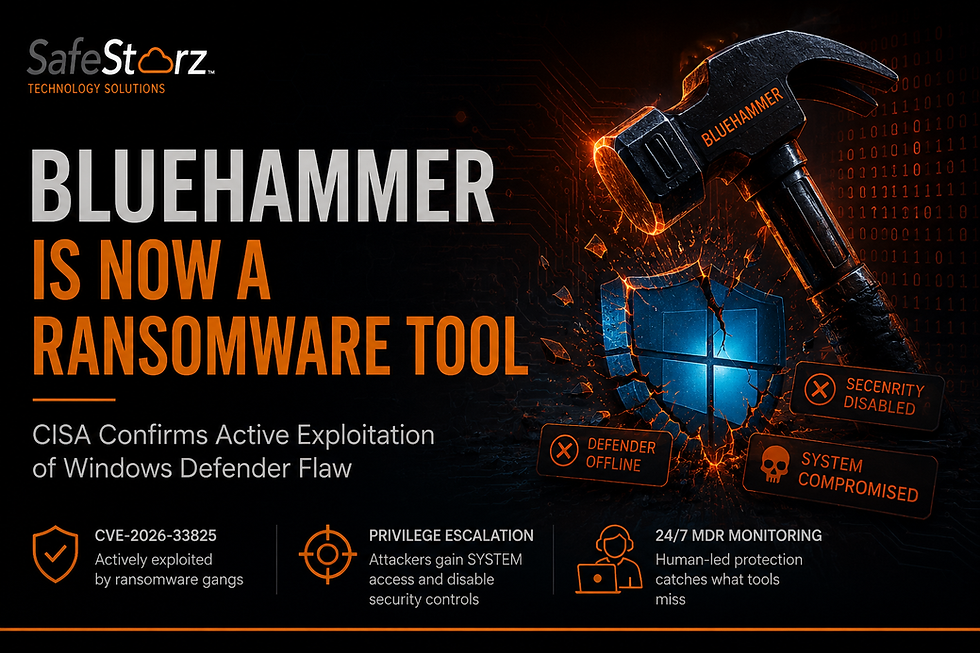
The Microsoft Defender privilege escalation vulnerability known as BlueHammer (CVE-2026-33825) is now being actively used by ransomware gangs, according to the Cybersecurity and Infrastructure Security Agency (CISA). What began as a publicly disclosed Windows vulnerability has quickly become part of real-world ransomware operations.
For businesses, this is an important reminder that applying patches is only one part of the equation. Modern ransomware campaigns move quickly, and attackers often weaponize vulnerabilities long before every organization has updated its systems.
At SafeStorz, we've seen the same pattern repeatedly: attackers rarely need sophisticated techniques when organizations leave known vulnerabilities unpatched.
What Is BlueHammer?
BlueHammer is a high-severity local privilege escalation vulnerability in Microsoft Defender tracked as CVE-2026-33825.
The flaw allows an attacker with local access to elevate privileges to SYSTEM, giving them the highest level of access available on a Windows machine. From there, attackers can disable security controls, install malware, move laterally through the network, and prepare systems for ransomware deployment.
Microsoft released patches in April 2026 after proof-of-concept exploit code was publicly released by security researchers, under the Chaotic Eclipse and Nightmare Eclipse aliases. Shortly afterward, CISA added BlueHammer to its Known Exploited Vulnerabilities (KEV) Catalog because attackers were already abusing it in the wild.
Now, CISA has confirmed something even more concerning.
Ransomware groups are actively using BlueHammer during attacks.
Why This Matters More Than Another CVE
Every month brings new vulnerabilities.
Most never become major problems for most businesses.
BlueHammer is different because it has progressed through every stage of the attacker lifecycle:
Public vulnerability disclosure
Working proof-of-concept exploit
Zero-day exploitation
Microsoft security update
CISA KEV listing
Active ransomware exploitation
That entire progression took about three months. The CISA KEV listing came just three weeks after public disclosure.
For IT leaders, the lesson isn't simply "patch faster."
The lesson is that attackers are reducing the time between disclosure and weaponization.
Organizations that delay patching by weeks or months are giving attackers exactly the window they need.

Attackers Don't Need Zero-Days Forever
One misconception businesses often have is that ransomware always relies on unknown vulnerabilities.
In reality, many successful attacks exploit vulnerabilities that already have patches available.
The challenge isn't Microsoft's ability to issue fixes.
The challenge is getting those fixes deployed consistently across:
Windows workstations
Servers
Virtual machines
Remote laptops
Hybrid environments
Legacy systems
One forgotten server or unmanaged endpoint can become the foothold attackers need.
That's why SafeStorz approaches vulnerability management as an operational process, not a monthly checklist.
The Hidden Risk of Technical Debt
BlueHammer also highlights another problem we frequently encounter during infrastructure assessments: technical debt.
Businesses often continue operating on infrastructure that "still works." Servers remain online years after deployment.
Applications depend on unsupported operating systems. Patching gets postponed because someone fears downtime. Individually, those decisions seem reasonable.
Collectively, they create environments where vulnerabilities accumulate faster than they're resolved.
We've worked with organizations that believed they were fully patched, only to discover unsupported systems, inconsistent update policies, and unmanaged devices that had quietly fallen outside normal maintenance routines.
Attackers don't care which system is newest.
They look for the one that hasn't been maintained.
Why Layered Security Still Matters
Applying Microsoft's patch is essential.
But patching alone doesn't eliminate risk.
There is always a window between vulnerability disclosure and remediation.
Organizations need visibility during that window.
SafeStorz combines several layers of protection to reduce exposure:
Managed vulnerability and patch management
Standardized Microsoft 365 and Intune security baselines
Cynet XDR for endpoint, identity, and network visibility
24/7 CyOps MDR monitoring and investigation
Private cloud architectures designed to reduce lateral movement
If an attacker attempts to exploit a vulnerable system before a patch is installed, security teams still need visibility into suspicious behavior.
Detection and response remain just as important as prevention.
Note what the vulnerable component is: Microsoft Defender itself. For many businesses, Defender is the only endpoint protection they run. Here, the security tool was the attack vehicle.
For a deeper look at why endpoint protection alone is no longer enough, read our article on Beyond Antivirus: Why SMBs Need Advanced Threat Detection Today.
The Real Challenge Isn't Applying One Patch
BlueHammer will eventually disappear from the headlines.
Another vulnerability will replace it.
Then another.
The organizations that consistently stay ahead are not the ones reacting to individual CVEs.
They're the ones building repeatable security processes that include:
Continuous patch management
Infrastructure lifecycle planning
Vulnerability monitoring
Identity security
Endpoint detection and response
24/7 security monitoring
Those capabilities reduce risk regardless of which vulnerability attackers choose next.
Don't Wait Until a Vulnerability Becomes Tomorrow's Ransomware Campaign
BlueHammer demonstrates how quickly known vulnerabilities can become active ransomware tools.
By the time CISA confirms widespread exploitation, attackers have often been using the flaw for weeks.
That's why SafeStorz focuses on proactive security rather than reactive cleanup.
Through managed infrastructure, Cynet XDR, 24/7 CyOps MDR, Microsoft security baselines, and disciplined patch management, we help businesses reduce the opportunities attackers rely on.
If you're unsure whether your environment contains unpatched systems, unsupported infrastructure, or other security blind spots, contact SafeStorz for a vulnerability and infrastructure assessment. We'll help identify where your greatest risks exist before attackers do.


