
Managed Cloud Services for Small Businesses: What to Look for in a Cloud Provider

Your business moves critical applications to the cloud because the infrastructure is supposed to be more reliable and easier to manage. Then an outage hits. An application slows down. A backup fails. A security alert goes unnoticed. Or the monthly cloud bill increases without a clear explanation of why.
Suddenly, "the cloud" is still an infrastructure problem. It is simply running somewhere else.
For small and midsized businesses without teams dedicated to cloud operations, that creates a difficult question: Who is actually responsible for keeping the environment available, secure, monitored, backed up, and performing the way the business needs?
That is where managed cloud services for small businesses are different from simply purchasing cloud resources.
A managed cloud services provider takes an active role in operating the infrastructure behind your applications. But not every provider manages that infrastructure the same way. Before trusting critical workloads to a cloud partner, businesses should understand exactly what is being managed, which technologies are being used, and what happens when something goes wrong.
What Are Managed Cloud Services?
Managed cloud services combine cloud infrastructure with ongoing technical management.
Rather than giving your business access to cloud resources and leaving your team responsible for the rest, a managed provider can oversee servers, operating systems, performance, monitoring, backups, security, troubleshooting, disaster recovery, and infrastructure planning.
SafeStorz's Cloud Managed Hosting services are built around that model. SafeStorz manages private cloud environments for business-critical workloads, including ERP systems, databases, virtual desktops, and other applications where downtime or inconsistent performance can disrupt operations.
The difference is not simply where the servers live. It is what happens behind the scenes to keep those servers running.
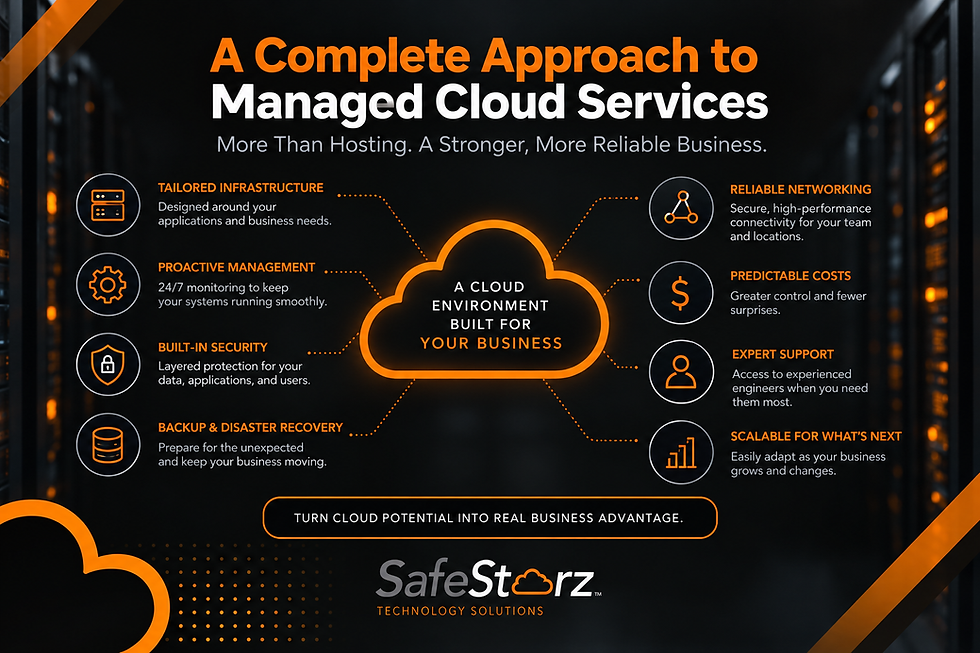
8 Things to Look for in a Managed Cloud Services Provider
1. Infrastructure Designed Around Your Workloads
A cloud environment should start with the application, not a predetermined package of computing resources.
An ERP environment may require a completely different mix of CPU, memory, storage performance, and networking than a virtual desktop environment or file server.
SafeStorz designs infrastructure around the actual workload and continuously tunes resources as those requirements change.
That includes CPU and memory allocation, storage performance, latency, throughput, and capacity planning.
Ask a prospective provider how it determines resource requirements and what happens when an application begins experiencing performance problems. A managed provider should be able to investigate the infrastructure supporting the workload, not simply recommend purchasing more resources.
2. Monitoring That Goes Beyond "Is the Server Online?"
Knowing whether a server is online is useful. Knowing that storage is approaching capacity, memory utilization is increasing, a backup has failed, or a network device is experiencing problems is much more useful.
SafeStorz uses PRTG for 24/7 infrastructure monitoring, with customized sensors and alerting based on the systems being managed.
That provides visibility into servers, networks, storage, applications, backups, and other critical infrastructure so potential problems can be identified before they develop into larger outages.
When comparing managed cloud providers, ask what they monitor, how alerts are prioritized, and what happens after an alert is generated. Monitoring only creates value when someone is prepared to act on what it detects.
3. Backup and Replication Designed for Recovery
Running something in the cloud does not mean it is adequately backed up.
A business still needs protection against ransomware, accidental deletion, software corruption, infrastructure failures, and other events that can make production data unavailable.
SafeStorz approaches this with StorzSnap, its proprietary ZFS-based snapshot and replication technology. StorzSnap enables efficient snapshots and replication between geographically separate infrastructure, helping SafeStorz build recovery and failover directly into managed environments.
That technology supports SafeStorz's broader Backup and Disaster Recovery strategy, which emphasizes recoverability rather than simply storing another copy of data.
As SafeStorz explains in Why Your Disaster Recovery Plan Fails, backups also need to be verified and tested. A backup job completing successfully does not matter much if the organization cannot restore the systems it needs during an actual disruption.
4. Security That Does Not Depend on One Layer
Cloud security should not rely exclusively on a firewall, antivirus program, or login policy.
SafeStorz uses Cynet XDR with 24/7 MDR as part of its layered cybersecurity strategy. Cynet provides extended detection and response across the environment, while around-the-clock MDR adds human security monitoring and investigation.
That matters because preventative controls can fail.
SafeStorz discussed this layered approach in its article on Microsoft Conditional Access vulnerabilities. Even when preventative policies are properly configured, behavioral detection provides another opportunity to identify suspicious activity if an attacker finds a way around those controls.
When evaluating providers, ask both what security technology they deploy and who is watching it. An alert sitting unnoticed in a dashboard does not provide the same protection as an actively monitored security environment.
5. Network Infrastructure Built for Cloud Availability
The cloud is only useful when employees and applications can reliably reach it.
Network architecture therefore needs to be part of the managed cloud conversation. SafeStorz's Network Infrastructure services support cloud, hybrid, and on-premises environments with network monitoring, segmentation, secure connectivity, and redundancy.
This becomes especially important when businesses rely on cloud-hosted ERP platforms and other applications throughout the workday.
Ask providers how network connectivity, redundancy, remote access, segmentation, and failover are incorporated into the environment. Cloud infrastructure and network infrastructure should be designed together.
6. Predictable Costs Without Hyperscaler Surprises
One of the attractions of cloud infrastructure is eliminating large upfront hardware purchases. But variable usage charges, data transfer fees, storage costs, backup charges, and other services can make some public cloud environments difficult to forecast.
SafeStorz uses a private cloud model with predictable monthly pricing, allowing infrastructure to be sized around actual business requirements without the same level of hyperscaler cost volatility.
There is also another consideration beyond price: dependency.
Customers stayed online through Azure, AWS, and Cloudflare outages because we design for isolation and failover.
That distinction is important. A lower cloud bill provides little comfort if an organization cannot access its critical applications.
Businesses evaluating cloud providers should therefore ask not only "What will this cost?" but also "What infrastructure are we depending on, and what happens when part of it fails?"
7. Engineers Who Understand the Environment
When a critical ERP system or business application becomes unavailable, submitting a generic support ticket is not much of a recovery strategy.
Businesses should know who will respond when infrastructure fails and whether that person understands the environment.
SafeStorz is built around a small, experienced infrastructure team rather than layers of ticket escalation. Its engineers work directly with private cloud, server, storage, networking, backup, and security environments, giving them visibility across the infrastructure when troubleshooting problems.
That can matter when the obvious symptom is not the actual problem.
A slow application could be caused by storage latency, constrained memory, network performance, a server issue, or something occurring inside the application itself. Effective troubleshooting requires understanding how those pieces interact.
8. An Infrastructure Strategy That Can Change With the Business
Managed cloud services should solve more than today's infrastructure problem.
Applications change. Storage grows. Companies add locations. Security requirements evolve. Older operating systems reach end of support. An infrastructure design that works today may need to look very different several years from now.
That is why SafeStorz approaches managed cloud hosting as an infrastructure partnership rather than simply renting virtual machines.
Resources can be adjusted as workloads change, while server management, backup, monitoring, networking, and security can evolve alongside the environment.
The objective is not to move everything possible into the cloud. It is to determine where each workload operates most effectively and build the infrastructure around that decision.
Private Cloud vs. Public Cloud for Small Businesses
Public cloud platforms such as Microsoft Azure and AWS provide enormous ecosystems, global reach, and virtually unlimited access to computing resources. They can be the right choice for many workloads.
But they are not automatically the right choice for every workload.
Private cloud environments can provide dedicated resources, greater isolation, more predictable performance, increased infrastructure control, and predictable monthly costs. For organizations running ERP platforms, databases, manufacturing applications, and other uptime-sensitive systems, those characteristics can be particularly valuable.
SafeStorz focuses on selecting infrastructure based on workload requirements rather than assuming everything belongs on one platform.
The result may be private cloud, public cloud, on-premises infrastructure, or a combination of environments.
The important question is not which cloud platform is the biggest. It is which architecture gives your applications the performance, security, recoverability, and availability your business requires.
Questions to Ask Before Choosing a Managed Cloud Provider
Before committing to a provider, find out who actually monitors the infrastructure, which monitoring platform they use, how backups are replicated and tested, how security alerts are investigated, where your workloads will run, and what happens when the underlying infrastructure experiences an outage.
Ask how quickly critical systems can be recovered. Ask how costs change when resources increase. Ask whether you will have access to engineers who understand your environment.
Most importantly, ask what the provider is responsible for after the migration is finished.
Those answers reveal the difference between purchasing cloud capacity and establishing a managed infrastructure relationship.
Build Cloud Infrastructure Around Your Business
Cloud hosting does not eliminate infrastructure management. Someone still needs to monitor systems, detect threats, protect data, maintain performance, plan for failures, and respond when something breaks.
SafeStorz combines managed private cloud infrastructure with PRTG monitoring, Cynet XDR with 24/7 MDR, StorzSnap backup and replication, geodiverse infrastructure, and direct engineering support to manage those responsibilities as one connected environment.
Instead of forcing business-critical applications into a generic cloud model, SafeStorz builds infrastructure around the workloads that depend on it.
If your organization is evaluating managed cloud services or reconsidering whether its current cloud environment provides the reliability, security, and cost predictability it needs, contact SafeStorz to discuss your infrastructure.


