How Managed Backup and Disaster Recovery Ensure Business Continuity: A Simple Guide for Growing Businesses

Every growing business faces risks that can disrupt operations, from cyberattacks to hardware failures. Without a solid plan, these disruptions can lead to costly downtime and lost data. Managed backup and disaster recovery (BDR) services offer a practical way to protect your business and keep it running smoothly, even when unexpected problems arise.

What Is Managed Backup and Disaster Recovery?
Managed backup and disaster recovery is a service where a third-party provider handles the backup of your critical business data and systems. This includes regularly copying your data to secure locations and creating plans to restore operations quickly after an incident.
Unlike simple backups, disaster recovery focuses on restoring your entire IT environment, including applications and infrastructure, so your business can continue without major interruptions. Managed services mean experts monitor and maintain these backups, reducing the risk of human error and ensuring your data is always protected.
Why Business Continuity Matters in 2026
In 2026, businesses rely more than ever on digital systems. Even brief downtime can mean lost revenue, frustrated customers, and lasting reputational damage.
Recent research found that most organizations could not survive more than three days of downtime, showing why backup and disaster recovery planning is essential.
Business continuity means your company can keep operating during and after disruptions. It builds trust with customers and partners and helps you meet regulatory requirements. With cyber threats increasing and technology becoming more complex, having a reliable backup and recovery plan is no longer optional.
Understanding RPO and RTO
Two of the most important terms in any backup and disaster recovery discussion are RPO and RTO.
Recovery Point Objective (RPO): The maximum amount of data your business can afford to lose, measured in time. For example, a 5-minute RPO means backups occur frequently enough that you would lose no more than five minutes of data.
Recovery Time Objective (RTO): The amount of time it should take to restore systems and resume operations after an outage. A shorter RTO means less downtime and faster recovery.
These benchmarks help businesses choose the right backup strategy based on how critical their systems are and how much downtime they can tolerate. The right provider should help you define realistic RPO and RTO targets that align with your operations.
Common Threats That Disrupt Operations
Several risks can interrupt your business operations:
Ransomware attacks: Modern ransomware often uses double extortion tactics, where attackers encrypt data and steal sensitive information, threatening to leak it unless a ransom is paid.
Power outages: Unexpected loss of electricity can shut down servers and cause data corruption.
Human error: Accidental deletion, overwriting files, or system misconfiguration can lead to outages or lost data.
Hardware failure: Physical components like hard drives, storage arrays, or network devices can fail without warning.
Each of these threats can cause downtime that lasts hours or even days, affecting productivity, customer service, and revenue.
How Managed Backup and Disaster Recovery Protect Your Business
Managed BDR services protect your business by:
Automating backups so data is copied regularly without manual effort.
Storing backups offsite or in the cloud to keep data safe from local disasters.
Monitoring backup health to catch issues before they cause problems.
Providing fast recovery options to restore data and systems quickly.
Testing recovery plans to ensure they work when needed.
This proactive approach reduces downtime and data loss, helping your business recover faster from incidents. The Cybersecurity and Infrastructure Security Agency (CISA) also recommends maintaining tested, isolated backups as part of a strong resilience strategy.

Key Features to Look For in a Managed Backup and Disaster Recovery Provider
When choosing a managed backup and disaster recovery provider, consider these features:
Comprehensive coverage: Backups should include files, applications, and system settings.
Encryption and security: Data must be protected during transfer and storage.
Flexible recovery options: Ability to restore individual files or entire systems.
Scalability: Service should grow with your business needs.
Regular testing and reporting: Providers should verify backups and share status updates.
24/7 support: Access to expert help anytime you face an issue.
Clear RPO/RTO commitments: Recovery expectations should be documented and measurable.
Selecting a provider with these qualities ensures your backup and recovery plan is reliable and effective.
Real-World Example of Downtime vs Preparedness
Consider two companies facing the same ransomware attack:
Company A had no managed backup solution. They lost access to critical systems for five days and faced expensive recovery costs, lost productivity, and reputational damage.
Company B used managed backup and disaster recovery services. Their provider isolated the threat, restored clean backups within hours, and minimized disruption to customers and staff.
This example shows how preparation can save time, money, and trust. IBM’s annual Cost of a Data Breach research consistently shows that business interruptions and recovery costs can be among the most expensive parts of a security incident.

What Sets SafeStorz Apart
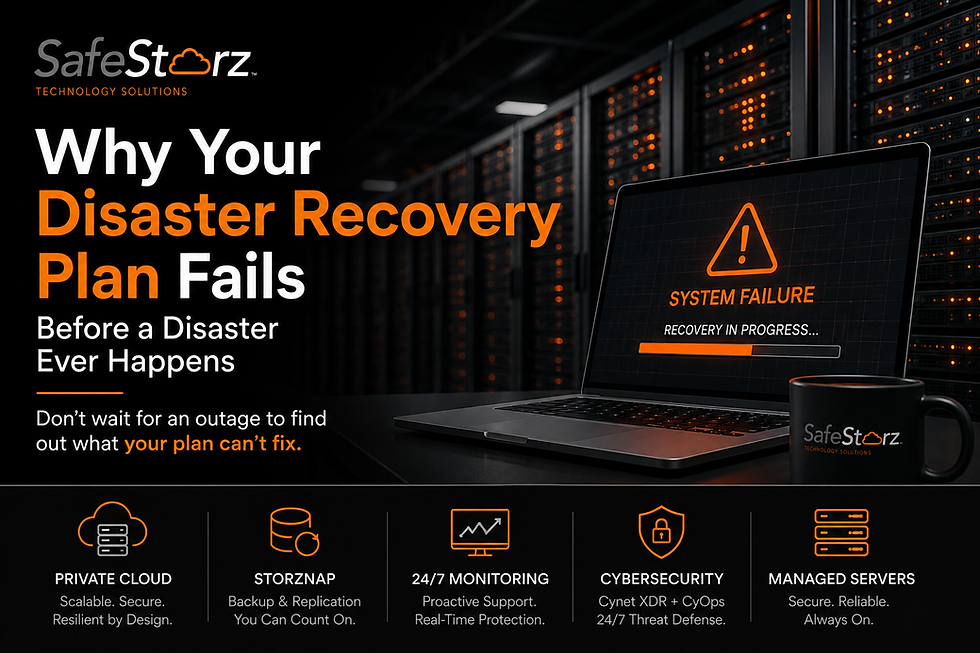
What sets SafeStorz apart is how backup has been built into the architecture from the start. Our StorzSnap solution delivers a 5-minute recovery point objective (RPO) with backups replicated across four separate arrays and two geographic locations. That means when something goes wrong, you are not waiting on a tape restore or depending on a single cloud region to recover.
Most clients are operational again within minutes. Because our infrastructure is private cloud, your backups never share resources with other organizations. That reduces shared risk exposure and gives you a more secure, predictable recovery environment. It is not just protection — it is protection you can measure.
Final Thoughts and Next Steps
Managed backup and disaster recovery services are essential for growing businesses that want to avoid costly downtime and data loss. By choosing the right provider and implementing a solid plan, you protect your business from common threats and ensure operations continue smoothly.
Start by assessing your current backup strategy and identifying any gaps in coverage, recovery speed, or data protection. From there, explore managed backup and disaster recovery providers that align with your business needs and budget.
If you’re ready to strengthen your business continuity and reduce downtime risk, contact SafeStorz to build a reliable backup and disaster recovery solution tailored to your organization. Taking these steps now can help protect your business from costly disruptions in the future.