
Managed ERP Hosting: 7 Things to Look for in a Provider

When an ERP system slows down or becomes unavailable, the effects rarely stay confined to IT. Orders can stall, production schedules can be disrupted, employees may lose access to financial or inventory data, and other everyday operations can quickly feel the impact.
The infrastructure underneath the ERP plays a major role in preventing those problems.
Slow servers, unreliable connectivity, inadequate backups, or poorly designed cloud infrastructure can turn an otherwise capable ERP platform into a source of downtime and frustration. For businesses considering a move away from aging on-premises infrastructure or reevaluating their current cloud environment, choosing the right ERP hosting provider is a critical decision.
Managed ERP hosting should provide more than somewhere to run an application. The right environment should be designed around performance, resilience, security, recovery, and the operational requirements of the business.
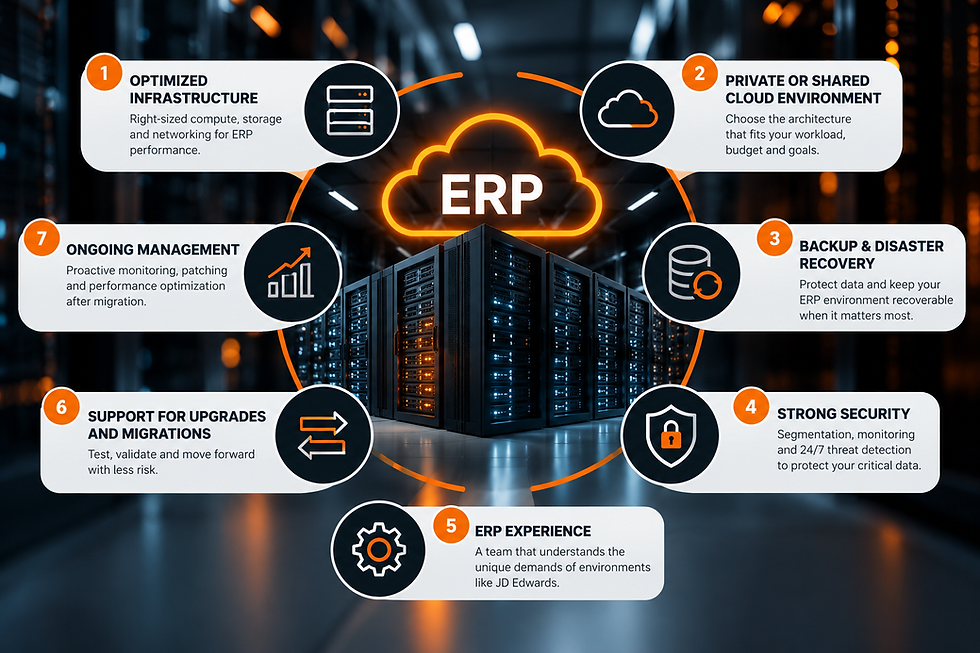
1. Infrastructure Designed Around Your ERP Workload
ERP systems can place significant demands on compute, memory, storage, databases, and network resources. Those demands can also change as transaction volumes grow, more employees use the system, or new integrations are introduced.
A generic cloud configuration may technically run an ERP application without being optimized for it.
A managed ERP hosting provider should evaluate the workload itself and allocate resources accordingly. That includes understanding CPU utilization, memory requirements, disk I/O, database performance, latency, and other factors that affect the user experience.
SafeStorz's managed cloud services are designed around business-critical applications and workloads, including ongoing performance tuning and resource optimization.
This is especially important when performance issues are mistakenly blamed on the ERP software. Sometimes, the problem is the infrastructure underneath it.
2. Private vs. Shared Cloud Infrastructure
Businesses should also understand exactly where their ERP will run.
Large public cloud platforms offer enormous flexibility, but not every ERP workload needs the complexity of a hyperscale environment. Businesses may encounter variable infrastructure costs, complicated service configurations, and environments that require substantial internal expertise to manage effectively.
Private cloud ERP hosting offers another approach.
A private environment gives more control over how compute, storage, networking, security, and backup are configured around a particular workload, and more predictable performance for critical systems. SafeStorz offers dedicated hardware when a business needs it.
SafeStorz has discussed this distinction in its article on AWS flat-rate pricing and SMB infrastructure. The important question isn't whether public or private cloud is universally better. It is which architecture best fits the workload, budget, internal expertise, and operational requirements of the organization.
For an ERP that employees depend on throughout the workday, consistency matters.
3. Backup and Disaster Recovery Built Around Business Operations
Having an ERP backup is not the same as being able to recover the ERP.
A provider should be able to explain how data is protected, where backup copies reside, how frequently critical information is replicated, and what happens when an ERP environment needs to be restored.
More importantly, recovery planning should reflect the impact downtime would have on the business.
How much data could the organization afford to lose? How quickly would systems need to return to operation? What happens if the primary environment is unavailable?
SafeStorz takes a restore-first approach to backup and disaster recovery, with capabilities including geographically diverse replication, isolated recovery environments, backup validation, and recovery planning for business-critical applications.
For ERP systems supporting production, logistics, finance, or customer operations, recovery cannot be an afterthought.
4. Security That Extends Beyond the Server
ERP systems often contain some of an organization's most valuable information.
Protecting that information requires more than securing a server or installing antivirus software. Security should account for identities, endpoints, networks, administrative access, remote connections, backups, and the infrastructure hosting the application.
SafeStorz uses Cynet XDR with 24/7 MDR as its security backbone, combining extended detection and response with around-the-clock managed detection and response. This provides automated threat detection and response across endpoints, identities, and networks, backed by human monitoring.
Network architecture is also important.
Segmentation can help limit unnecessary communication between systems and reduce how far an incident can spread if one part of the environment is compromised. SafeStorz's network infrastructure services incorporate network segmentation, monitoring, secure connectivity, and infrastructure management across cloud, hybrid, and on-premises environments.
For ERP hosting, businesses should ask providers how they control administrative access, monitor infrastructure, isolate critical workloads, and respond when suspicious activity occurs.
5. Experience With ERP Environments
There is a difference between knowing how to host a virtual machine and understanding how infrastructure affects an ERP environment.
A provider supporting ERP systems should be comfortable investigating application performance from the infrastructure layer. That means looking beyond whether a server is simply "up" and examining CPU, memory, storage I/O, network performance, and other dependencies.
SafeStorz has direct experience supporting ERP environments, including JD Edwards.
As discussed in The Hidden Risks of Unsupported Operating Systems and Legacy Servers, SafeStorz has used infrastructure monitoring to identify performance bottlenecks in a JD Edwards environment and improve throughput without requiring changes to the ERP application itself.
That distinction matters.
When an ERP slows down, organizations need a provider capable of determining whether the problem originates with the application, database, server resources, storage, network, or another part of the infrastructure stack.
6. A Safe Way to Handle ERP Upgrades and Migrations
ERP upgrades can introduce significant operational risk.
Businesses may need to update the application, operating system, database, integrations, or underlying infrastructure without interrupting day-to-day operations.
The hosting environment should make testing easier rather than turning every major change into a high-risk event.
Private cloud infrastructure can provide organizations with the flexibility to create separate environments for testing upgrades and migrations before changes reach production. This gives teams an opportunity to validate application behavior, integrations, performance, and compatibility before relying on the updated environment for day-to-day operations.
For businesses where ERP downtime affects production or revenue, the ability to test first can significantly reduce migration risk.
7. Ongoing Management After the Migration
ERP hosting doesn't end once the application moves into the cloud.
Servers still require patching. Resources still need to be monitored. Storage utilization changes. Performance requirements grow. Backups need validation. Security threats evolve.
Businesses should therefore evaluate what happens after implementation.
Does the ERP hosting provider proactively monitor the environment? Who handles operating system updates? Who investigates performance problems? How are capacity requirements evaluated? What happens when an alert occurs outside normal business hours?
Managed hosting should remove infrastructure management from the organization's growing list of responsibilities, not simply relocate the hardware.
Choosing the Right ERP Hosting Provider
The best ERP hosting environment is not necessarily the one with the most services, largest data center footprint, or most recognizable cloud logo.
It is the one designed around the way your business actually uses its ERP.
Before choosing a provider, understand how it will address:
ERP performance and resource allocation
Infrastructure isolation
Backup and disaster recovery
Network and access security
Monitoring and performance troubleshooting
Upgrades and migrations
Long-term infrastructure management
For businesses running JD Edwards and other business-critical ERP platforms, those considerations can directly affect productivity, operational resilience, and the ability to recover when something goes wrong.
SafeStorz provides managed private cloud infrastructure built for organizations where uptime and application performance matter. By combining cloud hosting, infrastructure management, backup and disaster recovery, network security, monitoring, and deep ERP experience, SafeStorz helps businesses build environments around their operational requirements instead of forcing critical applications into generic infrastructure.
Considering a new home for your ERP environment? Talk with SafeStorz about your current infrastructure, performance requirements, recovery needs, and long-term plans to determine what a managed ERP hosting environment should look like for your business.


